
Ralph Fletcher’s status as a writer and teacher is legendary in elementary schools. He is the author of many books for teachers and children. In this podcast, Ralph and Franki Sibberson talk about the value of mentor texts for teachers.
A full transcript is available below the video player.


Franki Sibberson: Ralph, some of your newest work centers around mentor texts. Can you tell us how you define mentor texts?
Ralph Fletcher: Well, I think mentor texts are any texts that you can learn from, and every writer, no matter how skilled you are or how beginning you are, encounters and reads something that can lift and inform and infuse their own writing. I’d say anything that you can learn from – not by talking about but just looking at the actual writing itself, being used in really skillful, powerful way. I also just want to say that I think that, unfortunately, mentor texts, like a lot of rich ideas in our field, has almost become commodified a little bit.
I was in a school and one teacher said, “We’re doing mentor texts,” and it becomes like this thing that we do, then there’s a list of books. Can you give us this -,” and it becomes this little, it’s a KWL. You know what I mean? And I would just hope that somehow – and I’ve thought about this in terms of, it’s something that when I wrote the latest book I almost thought about whether we should change the title, but it’s something that teachers recognize – but I hope it doesn’t become a cliche because I think that it’s a really powerful idea.
Franki Sibberson: Why do you think mentor texts are important for you as a writer and for the kids in writing workshops?
Ralph Fletcher: I was reading Stephen King’s book on writing – it’s called On Writing
I remember there was a biography of Bob Dylan that I read years ago, and Dylan was always trying to sell himself as the unwatched phenomenon who came out of nowhere and just created these unbelievable songs. But he was over at Dylan’s house and there were a couple of shelves of poetry, detailed and underlined and carefully annotated. It was clear that Dylan had studied poetry on his own, auto-didact, for years and years and years.
I think that you need to see somebody doing something in order to do it well yourself, whether it’s baking bread, whether it’s skiing, whether it’s writing. And I think writing is very complicated, so when you read a powerful piece, what’s really wonderful about that is you see it in its gestalt, all fitted together. You still need to, at some point, break down the individual — it’s like wanting to be a dancer and going to see the ballet. You’re inspired. You may not be able to do many of the moves that they’re doing on stage, but you definitely need that as your head as you try to become a better dancer.
Franki Sibberson: Like a vision. Do you think mentor texts can be taken from experts or do you think writers choose their own mentor texts, or not even choose them, maybe?
Ralph Fletcher: That’s an interesting issue. Well, I would say it like this. I think that for me as a writer — and I think this is true of the classroom, too — both things can happen. I think that somebody can give me something and say, “Listen, I want you to read this,” and maybe it’s not something that I would choose, but then after I read it and I really engage in it, it can change me as a writer. And I think with classroom teachers it’s the same thing. There are definitely times when the kids may not want to choose a particular piece, but the teacher reads it and the kids are like, “Wow.”
I’d say, for example, all modesty, a book of mine like Twilight Comes Twice
When I think of myself growing up, there were books that I read like The Call of the Wild
Franki Sibberson: Do you know, can you identify some mentor texts that you’ve learned from, as a writer?
Ralph Fletcher: That’s actually the session I’m going to do at NCTE. My part of it, I want to go through and I want to just look at some of the texts that I think are powerful and maybe even suggest connections between that texts and a book that I wrote. For example, Cynthia Rylant’s book, Night in the Country
I just love that book, and I don’t think it’s even a book that’s even talked about that much anymore as much as some of her books, but I think it was powerful for me as a writer. And I just want to say — and this is probably an obvious point but I’ve heard Lois Lowry make this point, too — when you write for kids, a writer like myself or any of the writers that we looked at who write for kids, I would really suspect that those writers are finding mentor texts in other writers who write for kids, as well as the classics and Shakespeare. In other words, I read a lot of powerful other texts that I think eventually do affect my writing for kids.
Franki Sibberson: Do you think that your mentor texts, that you learned from pieces of writing and they inform all of your writing, or do children’s books influence your children’s writing and professional book influence your professional writing, or does it all mesh together?
Ralph Fletcher: I think it meshes together, for me. Obviously the genre has some distinctions and we can recognize them, and we need to recognize what the purpose of the writer is when we’re reading something. But I think good writing has powerful metaphors, has great story, has unusual language use, so I do think it all meshes together. There’s that famous quote by Annie Dillard that “poetry is the school I went to to learn how to write prose.” I think that everything that you read that’s powerful really can inform your writing.
I remember a few years Rick Bragg — he wrote that book called All over but the Shoutin’
Franki Sibberson: I think this is probably repetitive but do you use mentor texts as a writer in the same way you see them being used in classrooms?
Ralph Fletcher: I think that mentor texts are being used in lots of different ways in the classrooms, and I think it’s generally — I mean, before we even start to look at it in smaller points — I think it’s a powerful thing that we’re saying to kids, “Let’s look at what real writers are doing. Let’s see how we can learn from these writers.” So I think that’s great. I’m all for that. I think, in fact, if you look at some of the older writing programs, I think that was one of the things that was lacking was some really powerful models, not just models that were created to show kids competent language but really interesting, lively models that would really inspire young writers. So we’re seeing more of that now, which is great, and I’m all for that.
One of the things I’m concerned about is that I feel like we do a lot of controlling — maybe that’s too strong a word — but we’re doing a lot of directing students what things to look at. I know I talked about that in the introduction in my book, that I think that sometimes we’re making the mistake of not really trusting that kids can find things for themselves to look at in a piece of writing. When you open up a piece of writing and you read it to the class, I guess I feel that, to a large extent, kids can go in there and find something that they can use as a take-away that would inform their own writing, and it may not be the thing that you point out.
And that’s an interesting thing because that’s probably always been true. If you do a mini-lesson on leaves, let’s just say, and you read the first paragraph or two of a novel. Maybe you read the beginning of Tuck Everlasting
Franki Sibberson: You have a new book coming out on mentor texts, a professional book. Can you suggest any book titles, either professional or children’s, that teachers will want to know about when looking for great mentor texts for their students?
Ralph Fletcher: You know, there is a lot of stuff that I think those of us in this field of language arts and literacy are always trading titles and looking for new books that are powerful. I’ve been interested in memoir lately so I really like Knucklehead
Franki Sibberson: I think you’re writing. I think what you said about trusting kids to find things is a whole different way to balance out what we direct kids to look at and trusting that they’re going to find themselves and inviting them to do that is a big message. Anything else you want to add?
Ralph Fletcher: I guess one of the things that I would say — and I talked about this at NCTE when I did my session — when you go back to Rosenblatt and you really talk about transactionalism, the texts is not synonymous with the novel. They are two different things, and everybody brings their own pace, and their own histories, and their own prior experiences to the texts. So what you would get out of reading The Hunger Games
So I think that this whole idea of giving kids more room to find things that move them is really in line with transactionalism, and I think we’ve kind of lost that a little bit. And JoAnn and I did a lot with the Craft Lessons
But I think that, in a spirit of Rosenblatt’s idea, that often times people make their own meanings in a way that’s totally different than what we expected, and I think that somehow we’ve got to embrace mentor texts in a way that makes room for kids to be making their own meanings and not just finding out exactly the thing that we direct them to find out.
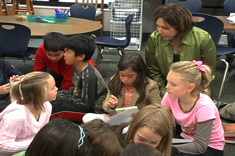

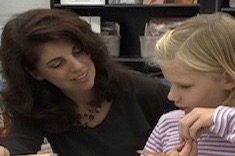
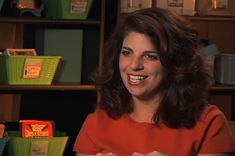
 as a mentor text. Aimee talks about mentor texts, using her own writing as a model, and the needs of intermediate readers and writers during the lesson and interview.